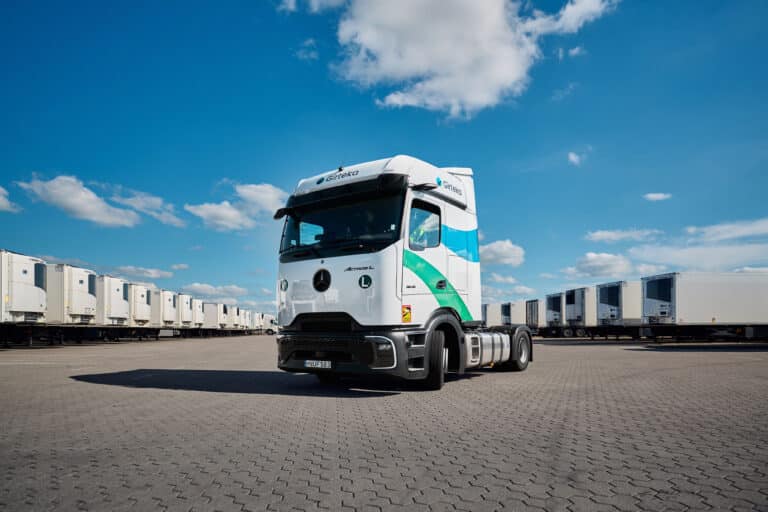


Balancing Emission Targets and Practical Solutions
Road transport is responsible for 755 Mt CO2[1] emissions today. However, the current situation in logistics doesn’t support a way to decarbonize it. Challenges along the way with infrastructure, technological barriers, costs, and market demands pave a struggling way forward. Despite that, carriers can already provide a better place for drivers, communities, and the overall us. Thanks to eco-driving, we can move closer to ambitious EU targets.
Today’s real landscape of trucks in the EU
According to ACEA[2], over 6.4 million medium and heavy commercial vehicles operate on European roads today, with roughly 80% of total freight tonne-kilometers carried by trucks under five years old. However, the average fleet age is about 14.2 years, reflecting broad differences among EU nations.
EU emissions goals and alternative fuels
The EU aims to cut heavy-truck CO₂ emissions by 2.5% annually to reach a 15% reduction by 2025 (relative to 2019), with a long-term objective of a 90% cut by 2040[3]. Achieving this goal will likely require significant advances in battery-electric or hydrogen fuel-cell trucks. However, today’s situation in the area of infrastructure and cost barriers continues to slow large-scale adoption. CNG and LNG alternatives also remain limited by refueling network constraints. This is a place where eco-driving can play a significant role.
Eco-driving stands out for its immediate potential. Structured programs across Europe have shown fuel consumption – and thus CO₂ emissions – can drop by 10–20% when such practices are fully adopted.[4] “Eco-driving isn’t just a buzzword – it’s a measurable way to cut costs and emissions almost overnight,” says Karolina Žekaitė, Head of Drivers academy at Girteka.
Emissions reductions at different scales
- A single truck traveling 120,000 km annually at 30-40 liters/100 km[5] burns about 33,600 liters of diesel. Each liter of diesel produces around 2.64 kg of CO₂[6], which yields roughly 96 tonnes of CO₂ per truck per year.
- A 10% cut in fuel use through eco-driving translates into more than 9 tonnes of CO₂ saved per truck.
- Applied to trucks older than 6 years (40%) across the EU, this cumulative benefit can reach 23 million tonnes in emissions reductions[7].
Improving driver operations and safety
However, eco-driving, despite the potential for reduction of emissions, also has a very good influence on road safety. “By adopting smoother driving habits, I’ve seen a drop in fatigue, and I’m less stressed at the end of the day,” notes Jurij, who recently finished Girteka’s eco-training.
Eco-driving focuses on steady acceleration, cautious braking, reduced idling, and route optimization. In-vehicle telematics tools help drivers and fleet managers pinpoint issues like harsh braking or high idle times.
Girteka’s approach: training, telemetry, and continuous improvement
In 2024, more than 7.000 Girteka drivers completed both theory sessions – covering fuel-saving techniques and safety measures – and practical lessons with an instructor.
“We provide real-time feedback to our drivers through an updated mobile system, so they can easily adapt their way of driving to exact results that are transferred to them via mobile solution,” explains K. Žekaitė. “That immediate visibility on speed, acceleration, and braking patterns helps them make adjustments on the road for better efficiency.”
A broader perspective and next steps
While modernizing fleets and exploring cleaner fuels remain vital for meeting the EU’s 2025 and 2040 emissions targets, eco-driving offers an immediate, cost-effective complement. It delivers measurable improvements in fuel efficiency, reduces costs, and often enhances safety.
Eco-driving is one of several tactics available to the freight industry, alongside accelerated fleet renewal and alternative fuels. Girteka’s driver training programs indicate that even small per-vehicle gains can yield significant environmental and economic advantages when multiplied across Europe’s vast trucking sector. To reach ambitious emission goals, industry stakeholders may combine multiple strategies – modern vehicles, expanded infrastructure for alternative fuels, and well-structured driver education – to ensure immediate and long-term progress.