

How the January 2026 deep freeze exposed critical vulnerabilities in European logistics and what it means for your freight?
Extreme cold represents a persistent and material operational risk within European transport networks. Unlike heatwaves, which typically create gradual performance degradation, low temperatures produce abrupt reductions in mechanical reliability, infrastructure capacity, and network efficiency. These effects are not isolated to local conditions, but in fact, they spread across interconnected corridors, generating system-wide delays and service disruptions.
The January 2026 cold wave across Europe provided a clear demonstration of this reality. For logistics service providers and shippers, this raises a practical question: what does extreme cold mean for operational reliability, and how should it be addressed in transport planning to ensure efficiency amidst increasingly volatile winter conditions?
January 2026 Case: A System-Wide Stress
Europe entered January 2026 amid one of the most disruptive winter cold waves recorded in over a decade, providing a relevant case study in network-level disruptions. The event impacted air, sea, and road networks simultaneously, affecting operations across multiple countries and exposing structural vulnerabilities in the European logistics system.
An Arctic blast brought widespread snow and ice, with temperatures falling below –30 °C in northern Sweden and Finland and approaching –40 °C in parts of northern Scandinavia. The Baltic region experienced similar conditions; Lithuania recorded extreme cold of –34.3 °C in late January (the lowest record in 30 years). Western and Central Europe faced extensive snow, frost, and hazardous road conditions, with official meteorological warnings issued across countries such as France, Italy, Belgium, Germany, and the Netherlands.
The operational impact was measurable across all major transport modes.
Air Transport Disruption
Major European airports experienced significant operational constraints. At Amsterdam Schiphol, one of Europe’s primary cargo and passenger hubs, over 2.400 flights were cancelled within a single week, with more than 600 cancellations occurring on a single day. Vienna, Budapest, Prague, and Bratislava also experienced temporary closures or substantial capacity reductions.
The impact on cargo operations was direct: reduced uplift capacity, delays to time-critical shipments, and bottlenecks throughout international supply chains as freight volumes accumulated without adequate transport capacity.
Maritime and Port Operations
Operations at major North Sea ports, including Rotterdam, Hamburg, and Antwerp, experienced measurable slowdowns. Freezing temperatures reduced crane performance, slowed yard equipment, and created hazardous conditions for ground operations, resulting in lower terminal activity.
The effect on inland transport was concrete: increased truck turnaround times, reduced container flow rates, and extended dwell times for both import and export cargo. Containers that typically clear terminals within hours remained in yards for multiple days.
Road Network Impact
Road networks experienced the most extensive disruption. In France, traffic congestion in the Île-de-France region exceeded 1.000 kilometers, prompting authorities to restrict heavy goods vehicles over 7.5 tonnes to enable snow-clearing operations. Italy activated national winter emergency protocols on major motorways, implementing controlled entry procedures and lane restrictions.
Drivers across the continent encountered reduced speed limits, increased stopping distances, localized closures, and delays extending from hours to days.
The pattern across inland, sea, and air networks was consistent: when extreme cold and hazardous conditions affect multiple network nodes simultaneously, transport systems experience structural disruption rather than isolated slowdowns.
The Economic Dimension
Extreme weather represents a quantifiable cost driver to European transport systems. The EU-funded EWENT project estimates that extreme weather events result in at least €15 billion in annual transport-system losses across Europe, with road transport identified as particularly vulnerable due to time-related delays, accident impacts, and reduced asset availability.
This aligns with data from the European Environment Agency (EEA). Between 1980 and 2024, weather-related extremes caused an estimated €822 billion in economic losses across the European Union. Notably, over €208 billion, approximately 25% of the total, occurred between 2021 and 2024, indicating a concentration of losses in recent years.
While floods and storms account for the largest proportion of weather-related economic losses, temperature-driven events remain significant. Climatological hazards, including heatwaves, wildfires, droughts, cold spells, and frost, account for approximately 8% of total recorded losses between 1980 and 2024, representing tens of billions of euros in damage to assets, infrastructure, and economic activity across the EU. In 2024 alone, these hazards generated an estimated €5.4 billion in economic losses, confirming that temperature extremes continue to represent a material cost factor for transport operations.
Delay Costs in Context
Although Europe does not offer a unified dataset on cold-related delay hours, the U.S. Federal Highway Administration (FHWA) provides useful comparative data: adverse weather conditions account for approximately 23% of all roadway delays, equating to over 32 billion lost vehicle-hours annually. Direct costs to the U.S. trucking sector are estimated between $2.2 billion and $3.5 billion per year (approximately €2.0 to €3.2 billion).
Taken together, these figures demonstrate that cold-related disruption is not occasional or incidental. It represents a structural cost factor within freight transportation systems, with measurable implications for cost efficiency, asset utilization, and operational performance.
Understanding Cold-Related Failure Modes
From an operational perspective, extreme cold behaves fundamentally differently from summer heat. Heatwaves tend to degrade performance gradually, allowing time for adaptive measures. Cold, by contrast, introduces threshold effects – specific temperature points at which systems that function normally begin to fail abruptly.
A fleet operating reliably at –5 °C may experience instability at –10 °C, with failure rates increasing sharply as temperatures decline further. According to Girteka maintenance experts servicing hundreds of trucks monthly across its Šiauliai and Poznań transport bases, the recurring technical issues observed during extreme cold are oftentimes concentrated around a limited number of vehicle systems that are particularly sensitive to freezing conditions.
At vehicle level, four areas are most susceptible:
- Electrical systems, where battery performance deteriorates rapidly in low temperatures. Reduced battery capacity increases the probability of starting failures, especially after overnight exposure. A battery that performs reliably at 0 °C may deliver only 40–50% of its rated capacity at –20 °C.
- Fuel systems, where low temperatures affect diesel flow. As fuel approaches its cold filter plugging point, gelling can occur, restricting flow through filters and lines. In parallel, AdBlue (diesel exhaust fluid) can freeze at low temperatures. This leads to engine power loss, unstable engine operation, or complete failure to start.
- Air and braking systems, where moisture present in air reservoirs can freeze. Ice formation affects air flow and brake responsiveness, increasing safety risks precisely when road conditions already demand greater braking precision.
- Traction and tire systems, where summer or worn tires lose elasticity and grip in cold weather. Reduced traction can lead to wheel spin, longer stopping distances, or becoming immobilized on icy surfaces, creating delays and safety risks.
- Ancillary systems, such as windshield washer fluid, can freeze if not adapted for winter conditions, reducing visibility during snowfall, road spray, or salt accumulation.
These failure modes are rarely isolated. When temperatures drop rapidly, multiple systems can be affected simultaneously, amplifying disruption across entire fleets. Girteka notes that many of these issues are preventable through seasonal preparation carried out in autumn, including replacing washer fluid and coolant with winter-appropriate options, changing oil to ensure proper performance in cold conditions, checking or charging the battery, and verifying overall vehicle readiness before the onset of winter.
In winter operations, reliability is therefore less about responding to breakdowns and more about ensuring that systems do not cross critical failure thresholds once extreme cold sets in. In practice, minimizing these risks requires not only technical adjustments but also consistent planning, clear processes, and coordination across the entire organization.
In practice, minimizing these risks requires more than technical adjustments. It depends on disciplined preparation across the entire organization.
“Extreme winter doesn’t just test our equipment, it tests our systems, discipline, and teamwork. For us, preparation is a season-long process that starts months in advance, covering maintenance, fleet readiness, route planning, and safety training. It’s a shared responsibility across the entire organization, and that’s what keeps freight moving safely and reliably in tough conditions."
Andrius Juknevičius, Head of Maintenance at Girteka Transport
Cargo-Specific Risk Assessment
The operational effects of extreme cold also translate into different risk profiles depending on cargo type. Exposure risk, failure modes, and operational consequences vary based on product characteristics and temperature requirements. Understanding these differences is essential for winter transport planning.
Effective risk management in winter conditions requires real-time visibility (RTV) throughout transit. Temperature monitoring systems enable early detection of system performance before entire loads can be compromised. This becomes particularly critical during extreme cold events, when external temperatures can affect refrigeration unit performance and when traffic delays extend the transit duration.
Food Products
Fresh and frozen food face distinct cold-related risks.
- Fresh food is vulnerable to sub-zero exposure. Cellular damage and cold burn occur rapidly, resulting in texture degradation, visual defects, and reduced shelf life. This damage is typically irreversible – product quality cannot be recovered even if temperature conditions stabilize.
- Frozen food, while thermally stable at low temperatures, creates operational challenges. Frozen door seals, ice accumulation, and pallets adhering to trailer floors increase unloading times and labor requirements. During peak winter periods, this reduces warehouse throughput when efficiency is most critical.
Beverages and Liquid Products
- Beverages are sensitive to freezing due to liquid expansion. Bottles crack, cans rupture, and packaging loses structural integrity. Products that do not show visible damage may experience separation or quality degradation, resulting in customer complaints and returns.
- Liquid or semi-liquid products such as detergents and cosmetics face comparable risks, with freezing potentially causing permanent separation or consistency changes.
Pharmaceuticals and Healthcare Items
- Pharmaceutical products transported within controlled temperature ranges (typically +2°C to +8°C or +15°C to +25°C) are highly temperature-sensitive.
- The primary winter risk is freezing, not heat exposure. Brief temperature excursions below specification can compromise product stability, therapeutic efficacy, and regulatory compliance.
Electronics and High-Value Goods
- High-value cargo and electronics face condensation risk from temperature transitions. Rapid movement between cold environments and heated facilities creates conditions for moisture accumulation, which can damage components, compromise packaging, and create corrosion.
- Battery-powered devices experience additional challenges, with reduced operational capacity and potential damage at sustained low temperatures.
Across all cargo categories, extreme cold increases freight exposure to risk. The consequences depend on product characteristics, required temperature ranges, and the duration of external stress during transit. Winter performance is therefore determined by how well transportation conditions are anticipated, monitored, and aligned with cargo requirements.
In this context, for cargo shippers, selecting a logistics service provider experienced in operating under extreme winter conditions becomes a defining factor in maintaining consistent performance. Carriers with long-established experience, such as Girteka, are better positioned to anticipate cold-related risks and maintain stable transport conditions that support cargo integrity and operational efficiency in transit.
At the same time, for logistics providers, being chosen as that partner is ultimately a matter of trust. It means moving beyond execution to the commitments behind the scenes and being accountable for cargo safety, timing, and continuity throughout the journey amid seasonal changes.
“Choosing a logistics partner is ultimately about trust. When customers hand over their cargo, they expect certainty. Our role is to take responsibility for that trust, combining industry knowledge, hands-on experience across diverse cargo, and continued investment in people, processes, and systems to ensure goods arrive safely, in full, and on time, regardless of the season or weather conditions.”
Adelė Lasionytė, Head of Business Development at Girteka Logistics
Fleet Age as a Winter Reliability Advantage
Maintaining performance under extreme winter conditions is rarely the result of a single factor. It reflects the combined effect of preventive maintenance practices, cargo-specific operational knowledge, real-time monitoring capabilities, and the physical resilience of the equipment itself. Among these structural enablers, fleet age plays a particularly important role.
According to ACEA’s 2026 report, there are 6.2 million trucks on EU roads, with Italy, Germany, and Poland accounting for the largest shares. The average age of these trucks is around 14 years, making them significantly older than most other vehicle types and placing them among the oldest fleets in the European transport sector.
This ageing trend reflects a broader challenge: many carriers in Europe operate with older equipment that, while compliant, may be less efficient and less capable in harsh winter conditions. Older vehicles are more likely to experience cold-related mechanical stress, require more frequent maintenance, and face a higher risk of weather-related delays, which are the factors that directly affect cargo security and schedule reliability.
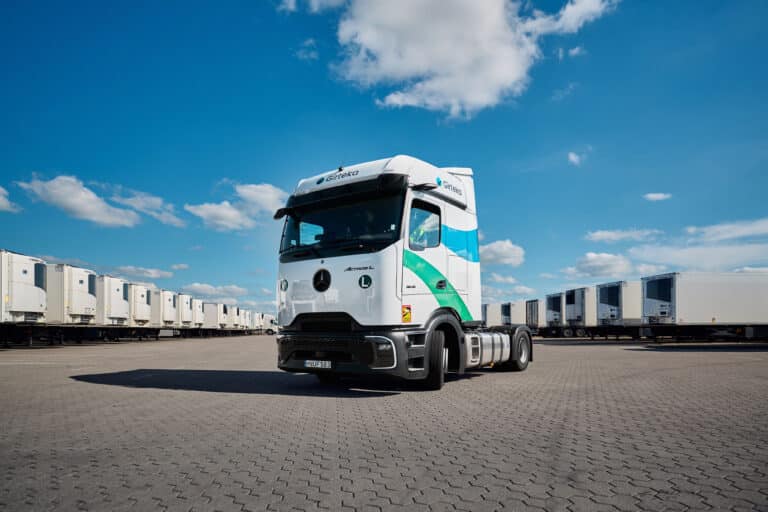
Against this backdrop, working with a carrier that operates a young fleet, such as Girteka, whose trucks average around 2.5 years, becomes a tangible advantage in winter logistics planning. A newer vehicle fleet tends to offer improved mechanical reliability, better integration with modern monitoring and control systems, and higher operational uptime in severe conditions. For shippers, this supports greater confidence that cargo can be transported consistently, even under prolonged winter pressure.
Why Cold-Chain Experience Matters in Winter
Working with an experienced refrigerated transportation provider can help reduce the operational complexity associated with winter logistics. Providers with extensive experience in handling a wide range of temperature-sensitive cargo and accustomed to cold-weather operations, are better equipped to manage seasonal risks through modern equipment, established operating procedures, and systems designed to perform more reliably in low temperatures.
For shippers, this typically results in:
- Greater confidence that temperature-sensitive goods remain within specified ranges
- Access to monitoring and alert systems that support ongoing visibility
- Continuous operational support and proactive issue resolution throughout transit
An effective cold-chain transportation partner functions as an integrated part of the supply chain rather than a transactional vendor. By working with a provider that is experienced in cold-chain and is prepared for winter conditions, businesses can maintain focus on core commercial activities while reducing the operational burden associated with temperature-controlled transport during colder months.
The January 2026 cold wave demonstrated that extreme winter conditions are not an anomaly, but a recurring stress factor for European supply chains. When temperatures drop sharply and remain low, operational reliability is shaped less by isolated incidents and more by how transport systems absorb pressure across assets, networks, and cargo flows.
In this context, the role of a logistics service provider extends beyond execution, supporting shippers with transport reliability, extra capacity, operational continuity, and the flexibility required to keep cargo moving efficiently across interdependent supply chains during prolonged winter conditions.