

As Europe’s summer travel season reaches its peak, millions of holidaymakers are taking to the roads. Girteka, a European road transport and logistics company operating a fleet of 6,500 trucks across the continent, is drawing attention to one road safety skill that is still too often overlooked: understanding how to drive safely around heavy goods vehicles.
Europe’s motorways become increasingly crowded during the summer months. According to a 2024 Ipsos and Europe Assistance survey, around half of Europeans prefer to travel by car for their summer holiday. In 2024 alone, 250 million cross-border tourist trips were recorded across the EU, with 44% of them made by private or rented car. The numbers speak for themselves. What this means is that millions of drivers who rarely venture beyond their regular commute suddenly find themselves on unfamiliar stretches of motorway, often alongside heavy freight traffic.
Heavy goods vehicles (HGVs) are a permanent feature of European roads, and summer is no exception. Yet research consistently points to a significant knowledge gap among car drivers when it comes to understanding how trucks move, what their limitations are, and how to behave around them.
A survey commissioned by National Highways – the UK government body responsible for the country’s motorway network – found that 36% of British drivers admit feeling nervous when passing trucks, and the same proportion did not even know how many blind spots an HGV has. Similarly, a representative survey ordered by the pan-European logistics operator Girteka revealed that half of the respondents felt unsafe in traffic near trucks – and only 37% rated their own knowledge of safe behaviour in such situations as good or excellent.
“The core issue here isn’t fear, but a lack of sufficient knowledge,” says Mindaugas Paulauskas, CEO of Girteka Transport. “Since feeling safe on the road is mostly a function of understanding how other vehicles – especially those of larger sizes – move. We should therefore focus not only on our reactions, but also on improving our awareness.”
Understanding how a truck actually moves is the starting point. Unlike a passenger car, a truck accelerates slowly, takes significantly longer to brake, and requires a wider arc to complete a turn. On motorways, the speed difference between a loaded truck and a car in the overtaking lane can make passing feel uncomfortable – but the hazard is rarely the truck itself. In most cases, the far more important factor is how the car driver maneuvers around it.
Artūras Pakėnas, a senior driving instructor and head of the Driving Instructors’ Club in Lithuania, works regularly with drivers who have anxieties around large vehicles.
“People are afraid of trucks, but they often don’t want to understand how they move. I hear it regularly – “Why should I care, I drive a car?” That’s exactly the wrong attitude. Knowing how a large vehicle behaves is basic road literacy, relevant to every driver,” A. Pakėnas says.
Key things every driver should know before sharing the road with a truck:
- Maintain more distance than you think you need. A fully loaded truck travelling at motorway speeds needs significantly more road to stop than a car. This applies not just to following distance, but also to pedestrian crossings – never assume a truck has seen you and is stopping until it has clearly done so.
- Understand where the blind spots are. Trucks have limited visibility to the sides, rear, and partially to the front. A simple rule applies: if you can’t see the driver in their mirrors, the driver may not be able to see you either.
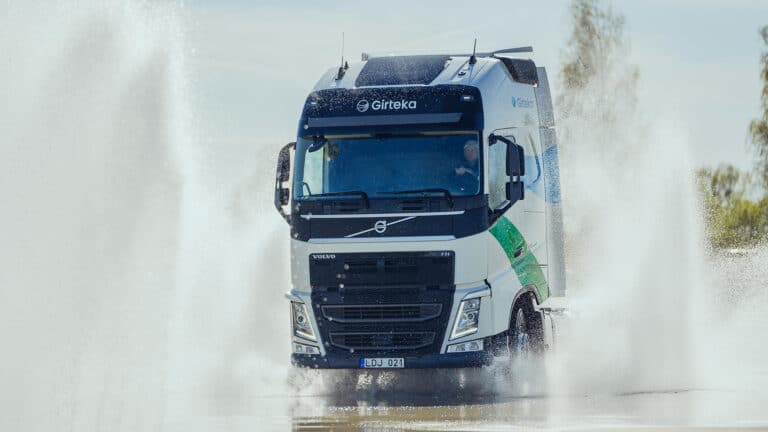
- Avoid driving alongside a truck for longer than necessary. Remaining parallel to a truck – particularly alongside the rear axle or trailer – may place your car in one of its blind spots. Poor weather makes the situation more dangerous, as spray from the wheels can further reduce visibility.
- Pay attention to the truck’s trajectory on turns and roundabouts. A truck turning at a junction or navigating a roundabout may need to swing wide and use more than one lane. Do not attempt to pass it on the inside. Wait until the manoeuvre has been completed and there is enough space to continue safely.
- Avoid sudden manoeuvres. Sudden lane changes, sharp braking, or cutting in front of a truck removes the driver’s ability to respond in time. To avoid getting into an accident, signal early, make your intentions clear, and leave additional space.
- Be patient when trucks reverse or exit narrow roads. Since their sightlines in these situations are severely restricted, do your best to keep a safe distance and avoid moving into a position where the driver may not be able to see you.
- Adjust for weather. Rain, snow, fog, and strong winds can affect visibility and a truck’s handling. Leave more space and avoid driving alongside a truck. In bad conditions, the safety margins around HGVs should increase accordingly.
As the summer holiday season continues, these principles are relevant both to experienced long-distance drivers and to people making their first major road trip of the year.
Alongside checking the route, arranging toll payments, and preparing the car, drivers should also take a few minutes to understand the largest vehicles they will share the road with. A little more knowledge, space, and patience can make summer journeys safer for everyone.