

The relentless pursuit of Vision Zero – the EU’s ambitious goal of zero fatalities and serious injuries on European roads by 2050 – has placed road safety under a microscope. While infrastructure and driver training are crucial, the focus has increasingly shifted to standardizing safety technology across all new vehicles. This effort is embodied by the EU General Safety Regulation (GSR), a sweeping regulatory framework designed to mandate advanced safety features.
But in an industry focused on efficiency and cost, a critical question remains: Do these regulations really make a tangible difference in the real world, or are they simply an exercise in compliance? For Europe’s largest asset-based logistics company, Girteka, the answer is a resounding yes – and the operational data provides the proof.
The EU General Safety Regulation – From Concept to Implementation
The General Safety Regulation (GSR) was introduced to significantly reduce the human error factor responsible for up to 90% of all road accidents. Its goal is to make vehicles inherently safer, better protecting both occupants and Vulnerable Road Users (VRUs), such as pedestrians and cyclists.
The implementation follows a phased approach:

Crucially for the logistics sector, the July 2024 deadline mandated a suite of sophisticated Advanced Driver Assistance Systems (ADAS) on all new trucks and buses. These now-mandatory technologies include:
- Blind spot detection
- Advanced emergency braking (AEB) systems
- Lane-keeping assistance
- Intelligent speed assistance
- Driver fatigue and attention monitoring
These regulations represent the foundation for future safety innovation, setting the stage for upcoming EU initiatives focusing on improved Direct Vision Standards (DVS) and the further evolution of ADAS toward automated driving capabilities.
New Trucks’ Safety and Market Context
According to Eurostat, there were over 4 million goods vehicles registered in the EU in 2024, a 1% increase year-over-year (YoY). During the same year, vehicles with a maximum permissible laden weight of more than 30 tonnes completed 83.1% of the EU’s total freight transport in tonne-kilometers (tkm).
One of the key pillars of the road safety reforms introduced by the Mobility Package is that new safety features will be mandatory in newly manufactured trucks. The good news, according to Eurostat data, is that HGVs that are less than two years old accounted for 20.2% of the total road freight transport performance in the EU, with tonne-kilometres increasing by 6.2% year on year. Vehicles between two and five years, meanwhile, held the highest market share, 39.8%, a decrease of 2.8% YoY.
Manufacturers’ Role – Innovation through Collaboration
The effectiveness of the GSR is also a testament to the innovation shown by major Original Equipment Manufacturers (OEMs). Partners like Volvo, Scania, Mercedes-Benz, DAF, and MAN have risen to the challenge, incorporating the complex mandated systems into their latest vehicle platforms.
The GSR has accelerated the deployment of technologies that were previously optional, such as advanced versions of Advanced Emergency Braking (AEB) systems that can detect pedestrians and cyclists, and more sophisticated Lane Keeping Assistance that actively intervenes. Manufacturers are not only complying with regulation – many are competing to exceed it. For them, safety innovation has become a strategic differentiator.
For example, Scania said that while the EU had mandated that new trucks from July 2024 had to be compliant, the manufacturer’s trucks already had “most of the required safety assistance technology.” DAF promised that every model of its trucks’ lineup would be compliant with the GSR’s first phase, which includes active and passive safety features. The former includes such Advanced Driver Assistance Systems (ADAS) as Forward Collision Warning, Lane Departure Warning System, Emergency Brake Lights, DAF Side & Turn Assist, and DAF’s Advanced Emergency Braking System.
Volvo had deemed that the new safety regulations would save lives, with Anna Wrige Berling, Traffic and Product Safety Director at Volvo Trucks, predicting that more active safety technology could be in the works in the near future.
“Looking further ahead, trucks will become more intelligent and more active when it comes to safety, with more features that intervene rather than just inform.”
Berling emphasized that there will be a need to balance the technologies with “a well-trained driver,” who is “still the most important safety system in the truck.”
"The EU's GSR is a powerful market signal that pushes safety technology from a premium add-on to a universal standard. The collaboration between fleet owners like Girteka, who provide the data and demand, and manufacturers, who provide the engineering, is what makes Vision Zero achievable."
Dainius Augutis, Transport Function & Support Department Manager at Girteka Transport.
From Regulation to Results – The Girteka Case
The real test of any regulation lies in its measurable effect on the ground. For Girteka, a company operating a vast, modern fleet, the immediate uptake of GSR-compliant vehicles has yielded tangible safety dividends.
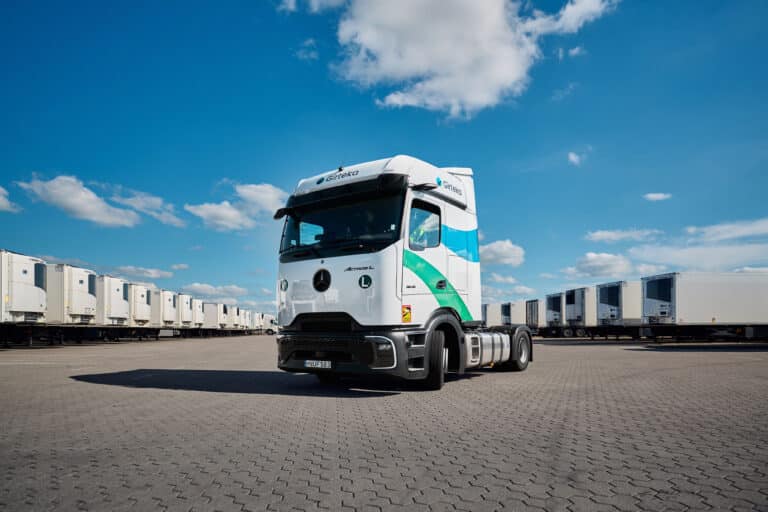
Girteka has been highly proactive in modernizing its fleet, adding over 2,400 new GSR-compliant trucks since the July 2024 implementation deadline. This commitment continues with plans to invest in up to 8,000 trucks and trailers within 2025–2026, solidifying its position at the forefront of the industry’s transition to safety-by-design standards.
The data from this rapidly renewed fleet is compelling. Girteka’s internal fleet and accident statistics for 2023–2025 show a measurable accident reduction – within a year, accidents involving these new trucks have decreased by 10%.
This measurable safety improvement is concentrated precisely where the new systems are designed to intervene. The biggest impact is seen in:
- Low-speed manoeuvres
- Small-movement collisions
- Blind spot–related incidents
These are precisely the areas the advanced safety technologies – such as the Blind Spot Information System (BSIS) and Moving Off Information System (MOIS) mandated by the GSR – were engineered to address, protecting vulnerable road users in complex urban and yard environments.
The improvement stems from a powerful combination of factors:
- Modern fleet equipped with advanced systems
- Data-driven driver training built around real behavioural patterns
- Continuous monitoring and analysis of incident scenarios
- High adoption rate of new trucks compared to industry averages
While Advanced Driver Assistance Systems (ADAS) are essential for crash avoidance, the industry consensus remains clear: the driver is, and will remain, the most important safety system in the truck. Large European trucking companies, such as Girteka, emphasize the importance of drivers’ training: not only the basic training for drivers who are starting their road trucking careers, but also topic-specific and in-depth learning modules for experienced professionals. Girteka’s Drivers Academy offers training curricula that include eco-driving and safe driving techniques.
During the company’s annual recurring training, drivers go through rigorous programs focused on safety, which include first aid drills to ensure that the company’s drivers can take care of other road users as well.
As stated by Dainius Augutis, early results show that safety improvements are not only theoretical – they are observable in everyday operations: „What we see today is measurable change, driven by the trucks already on the road. The mandated technologies have already reduced accident rates in our operations by 10%, proving that it works not only at the regulation and manufacturing levels, but also in daily transport operations.“
Human Impact
Beyond the hard metrics and efficiency gains, the most meaningful effect is human: drivers experience a lower risk of accidents and the associated trauma, leading to better well-being and safer working conditions. Simultaneously, communities face fewer risks from heavy vehicles, enhancing overall road safety in complex traffic environments, and clients benefit from reduced operational disruptions, cementing Girteka’s reputation as a safe and reliable logistics partner.
Broader Impact and Next Steps
The introduction of ADAS technology under the GSR delivers significant societal benefits by reducing accidents and lowering the associated societal costs, such as those related to emergency services, healthcare, and congestion. Furthermore, by reducing vehicle downtime and enhancing predictability, the Girteka case demonstrates that safety excellence is synonymous with operational excellence. For companies and their clients, investing proactively in these technologies results in more reliable logistics chains and better business continuity.
The Girteka case clearly illustrates that well-designed regulation, paired with a commitment to modern fleet investment, is the most effective accelerator for road safety innovation. Moving forward, the industry must continue to leverage the rich data generated by these new ADAS systems to refine driver training and influence the next generation of EU safety standards, ensuring that technology and regulation continue to work hand-in-hand to shape a safer, smarter future for logistics.